
Managing Director, Comtel
Where Artificial Intelligence, High-Performance Computing and Low-Latency Connectivity Meet Financial Markets
India’s rapidly expanding capital markets are creating new demand for AI-based data centres and specialised stock trading infrastructure. The growth of algorithmic trading, quantitative strategies, high-frequency trading and artificial intelligence (AI) is changing the way market participants consume data, develop trading strategies and execute transactions.
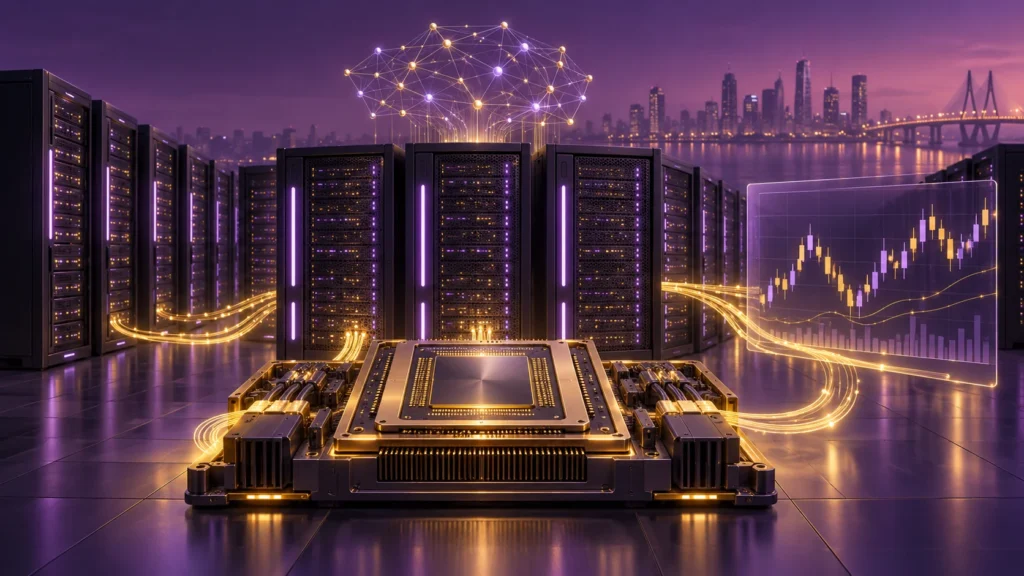
An AI-based financial data centre can bring together high-performance computing, GPU computing infrastructure, real-time market data, low-latency connectivity and advanced AI models in a single ecosystem.
Financial-market infrastructure is highly regulated. Any model involving exchange connectivity, algorithmic trading, market data or order execution must comply with applicable SEBI and exchange requirements. It is therefore important to clearly distinguish between providing technology and data-centre infrastructure and conducting regulated trading or investment activities.
AI in Algorithmic Trading: From Speed to Intelligence
Traditional high-frequency trading has focused heavily on speed and latency. AI introduces another dimension: the ability to analyse enormous quantities of information and identify patterns in real time.
An AI trading platform can process market prices, order books, volumes, futures and options data, open interest, volatility, corporate announcements, news, global markets and other alternative data. Machine-learning models can then identify trading patterns, estimate probabilities and generate signals for automated execution.
The objective is not to predict the market with certainty, but to identify small statistical advantages that can potentially be converted into trading opportunities through disciplined execution and risk management.
Why Low-Latency Trading Infrastructure Matters
For low-latency strategies, physical proximity and network connectivity to the exchanges remain critical. Servers located closer to exchange infrastructure can reduce the time required to receive market data and transmit orders.
At the same time, many AI-driven strategies do not require microsecond execution. They may operate over seconds, minutes or longer periods and therefore require substantial GPU/CPU computing, data processing and model-inference capabilities.
This creates an opportunity for a new generation of financial data centres combining:
Exchange Connectivity + Low-Latency Networks + CPU/GPU Computing + AI + Market Data + Risk Management
Financial AI Data Centres: A New Business Opportunity
A specialised financial AI data centre could serve proprietary trading firms, brokers, quantitative trading companies, fintech businesses, institutional investors and algorithm developers.
Revenue need not be limited to traditional rack rental. Potential services include:
- Rack, power and cooling
- High-speed telecom connectivity
- Exchange connectivity and cross-connects
- Dedicated high-performance servers
- GPU-as-a-Service
- AI model hosting and inference
- Market-data processing
- Quantitative research and back-testing infrastructure
- Disaster recovery and managed infrastructure
This creates the possibility of transforming a conventional data centre into a financial technology infrastructure platform.
Mumbai: A Natural Financial AI Hub
Mumbai is particularly well positioned for this opportunity because of its concentration of stock exchanges, brokers, banks, institutional investors, fintech companies, telecom networks and data-centre infrastructure.
A strategically located facility with diverse fibre connectivity, reliable power, high-density cooling and access to financial-market networks could become a specialised hub for India’s next generation of algorithmic and AI-driven trading.
The Regulatory Dimension
Financial-market infrastructure is highly regulated. Any model involving exchange connectivity, algorithmic trading, market data or order execution must comply with applicable SEBI and exchange requirements. It is therefore important to clearly distinguish between providing technology and data-centre infrastructure and conducting regulated trading or investment activities.
The Road Ahead for AI-Based Data Centres
The future of financial trading infrastructure is likely to be built around the convergence of speed, computing power and intelligence.
The most compelling opportunity may therefore not be simply to build another data centre, but to develop a Financial AI Data Centre that combines low-latency connectivity, high-performance computing, GPU infrastructure, market-data capabilities and financial technology services.
As AI becomes increasingly embedded in trading and investment decisions, such infrastructure could become a critical component of India’s evolving capital-market ecosystem.